
How to Fix Bare and Brown Spots in a Florida Lawn
Fix bare spots in a Florida lawn: identify the cause first — fungal disease, chinch bugs, drought, or physical damage — then match the repair.
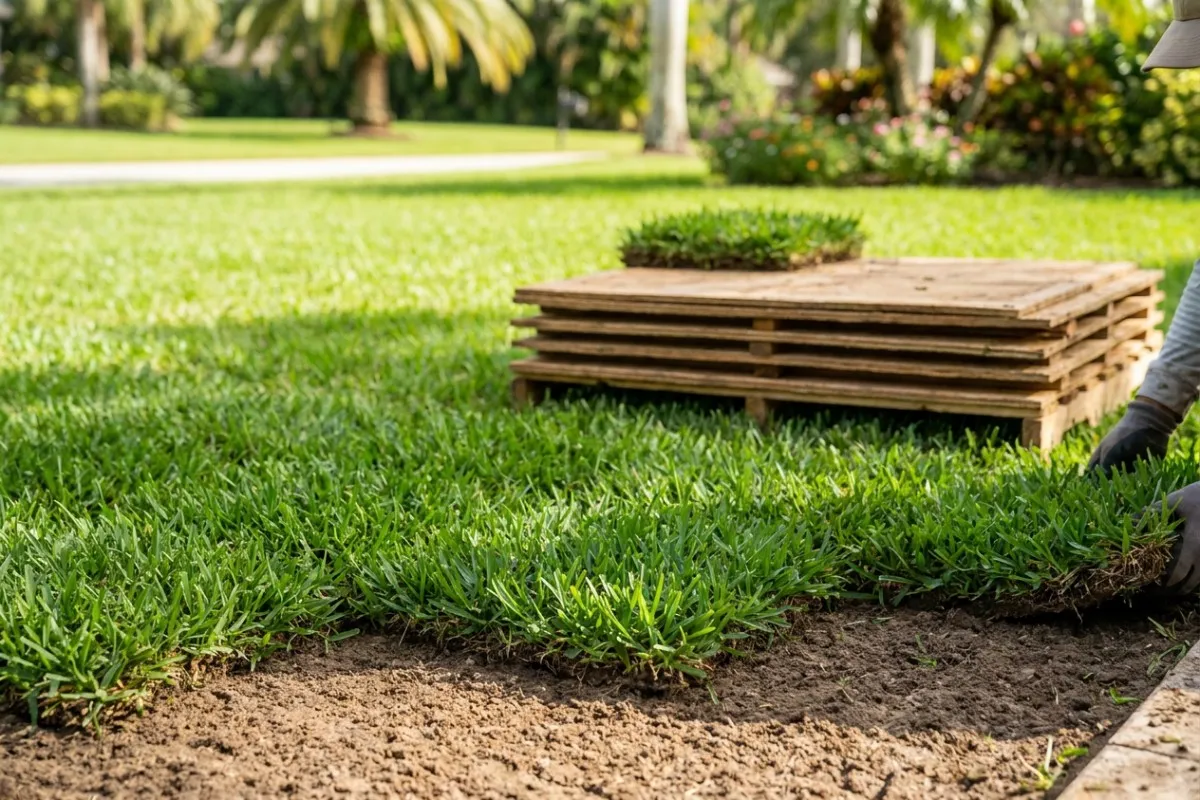
Bare patches and brown streaks are the most common lawn complaint Tampa Bay homeowners bring up after a Florida summer — and among the most commonly mishandled repair jobs. The instinct is to water more, apply fertilizer, or lay down replacement sod. None of those steps hold if the underlying cause is still present. To properly fix bare spots in a Florida lawn, diagnosis has to come before treatment. Treating drought stress with fungicide, or adding more water to a chinch bug outbreak, does not just fail to help — it can compound the damage.
This guide structures the repair process as a triage tree: four distinct causes with different visual signatures, different field tests, and different repair protocols. The repair method that works is the one matched to the actual cause.
What Creates Bare and Brown Spots in Florida Lawns?
Florida’s climate — sandy soils, intense summer heat, high humidity, and alternating drought-and-flood cycles — creates conditions for multiple distinct turf failure modes. In Tampa Bay area lawns, four causes account for the large majority of patchy and bare grass:
- Large patch (fungal disease, Rhizoctonia solani)
- Chinch bug damage
- Drought stress or irrigation failure
- Physical and chemical damage (foot traffic compaction, fertilizer burn, fuel spills, dog urine)
Each one looks similar from a distance. Getting close and reading the specific signs is what separates a repair that holds from one that fails within weeks.
How to Fix Bare Spots in a Florida Lawn: Diagnose the Cause First
Step 1 — Read the Shape and Location
The pattern of damage provides the first clue before you touch a single blade of grass:
- Roughly circular or arc-shaped patches, often with a darker outer ring, appearing in fall or winter — strong indication of large patch fungal disease
- Irregular, expanding patches in the hottest, most sun-exposed areas of the lawn, worst during summer dry stretches — consistent with chinch bug damage
- Uniform thinning or bluish-gray grass near driveways, sidewalk edges, or between sprinkler heads — likely drought stress from irrigation gaps
- Sharply defined dead zones matching a foot path, parking area, pet route, or equipment track — physical or chemical damage
Step 2 — Run Field Tests
Pull test — for fungal disease. Grip a grass blade at the outer edge of the affected area and pull gently upward. If it slides off the stem with almost no resistance and the base is dark, mushy, or smells of rot, fungal infection is the probable cause. Healthy or drought-stressed grass holds firmly at the base.
Float test — for chinch bugs. Cut both ends off a metal coffee can or similar cylinder and press it two to three inches into the soil at the green edge of a suspect patch. Fill it with water and watch for two minutes. Chinch bugs float to the surface; if you see small black-and-white insects rising, you have pest pressure, not a moisture or disease problem.
Screwdriver test — for drought. Push a standard screwdriver six inches into the soil in the damaged area. In a well-irrigated Tampa Bay yard, it should slide in with moderate hand pressure. If it meets hard resistance before six inches, the root zone is dry and compacted — an irrigation gap or coverage failure is likely the primary driver.
Step 3 — Cross-Reference with Season
Timing is a critical filter. UF/IFAS identifies large patch as most active when soil temperatures drop below 70°F, typically from November through May in Central Florida. If patches appeared during a hot, dry stretch in July or August in a full-sun area, fungal disease is a low-probability diagnosis. Chinch bugs, by contrast, are most destructive during exactly those hot, dry summer periods — the direct opposite of large patch weather.
Cause 1: Large Patch (Fungal Disease)
Large patch, caused by Rhizoctonia solani, is the most common fungal disease in Florida St. Augustine lawns. The presentation is a circular or arc-shaped dead zone — anywhere from a few feet to twenty or more feet across — with a distinctive darker “smoke ring” of actively dying grass at the margin and sometimes a greener center as the pathogen moves outward.
The outer edge is where diagnosis is most reliable. Pull a blade there, and the rotted, dark base confirms the pathogen.
Why it develops. The organism is present in virtually every Florida lawn soil. It becomes destructive when cool temperatures, high humidity, and prolonged moisture — especially overnight — allow it to colonize the leaf sheaths at the soil surface. Nighttime temperatures between 50°F and 70°F combined with wet conditions are the primary trigger. Shaded areas stay wet longer after rain, which is why large patch damage often concentrates under tree canopy and near structures.
Repair protocol. Stop nighttime irrigation immediately — water only in the early morning so blades dry before evening. During Florida’s rainy season, supplemental irrigation may not be needed at all. Apply a fungicide labeled for large patch or Rhizoctonia in warm-season turf, following label rates; a second application two to four weeks later is frequently recommended to prevent rebound. Once the disease is stopped, assess what remains. Sections where crowns are fully dead will not recover on their own and need to be resodded. Applying new sod over active fungus without treating first is one of the most common — and costly — repair errors.
For a closer look at managing fungal pressure in shaded areas during the wet season, our guide on protecting St. Augustine through Florida’s rainy season covers the preventive steps that matter most.
Cause 2: Chinch Bug Damage
Southern chinch bugs (Blissus insularis) are the most damaging insect pest of St. Augustinegrass in Florida, according to UF/IFAS, and Tampa Bay lawns bear the brunt of that pressure every summer. They use piercing mouthparts to extract plant fluids and simultaneously inject a toxin that blocks water movement in the grass. The lawn turns yellow, then straw-brown, and the damaged area continues expanding outward as long as the population is active.
The damage pattern is irregular and tracks the hottest, driest, most sun-exposed zones — the opposite of fungal damage, which favors shade and moisture. Floratam, the most widely planted St. Augustine variety in this region, has largely lost the chinch bug resistance it was originally released with, making it the most vulnerable variety in Tampa Bay suburban lawns today. Homeowners dealing with recurring pressure may want to evaluate more resistant cultivars — our guide to St. Augustine varieties for Tampa Bay compares the options.
Repair protocol. Confirm presence with the float test before applying any insecticide. Once confirmed, treat with a product labeled for chinch bugs in residential turf, applied to the damaged area and a buffer zone at least three feet into the surrounding healthy grass. A second application two weeks later addresses newly hatched nymphs and breaks the population cycle. After pest pressure is eliminated — and not before — remove and replace the dead sections with fresh sod. Replacing turf into an active infestation wastes both money and material.
Cause 3: Drought Stress and Irrigation Failure
Drought stress is regularly misidentified as disease or pest damage. The key distinction: drought-stressed St. Augustine curls its leaf blades lengthwise, turns blue-gray before it browns, and recovers relatively quickly once deep irrigation is restored — provided the roots are still alive. Disease and pest damage do not recover with water alone.
Common irrigation failures in Tampa Bay lawns include misaligned or blocked sprinkler heads leaving dry corridors, timers not adjusted after seasonal changes, and shallow root systems in lawns that have received frequent but light irrigation rather than deep, infrequent cycles.
Repair protocol. Walk the irrigation system during a full run cycle and look for gaps in coverage — areas where heads do not overlap and the soil stays dry. Adjust or replace components as needed, and shift to a deep-and-infrequent schedule: approximately half an inch of water per zone, two to three times per week during active growth, adjusted down during periods of regular rainfall. Sections where roots are fully dead and the screwdriver test still shows hard, compacted soil after several corrective watering cycles need to be replaced with new sod. Once the irrigation coverage problem is resolved, new sod establishes readily.
Cause 4: Physical and Chemical Damage
Physical damage has sharply defined edges that correspond to the source. Foot traffic compacts soil over time, starving roots of oxygen; the dead zone follows the path exactly. Fertilizer burn creates geometric dead patches that match the spreader pattern or a spill site. Dog urine creates small, roughly circular dead spots with a ring of darker, greener grass at the margin — the concentrated nitrogen in the center kills the turf while the diluted perimeter acts as fertilizer. Fuel and chemical spills produce irregular but contained dead zones, sometimes with a distinct odor.
Repair protocol. Eliminate the source before attempting any repair. Redirect foot traffic, install stepping stones where heavy use is unavoidable, flush the soil thoroughly with water after fertilizer or chemical incidents. For small areas under two or three square feet, sod plugs cut from a fresh pallet and pressed firmly into prepared soil work well. For larger areas, cut out the dead material, loosen and lightly level the exposed soil, and install new sod with tight seams. The new turf will not anchor if the compacting or chemical stress continues after installation.
Why St. Augustine Patch Repairs Always Require Sod
St. Augustine grass does not produce viable seed commercially — every repair, from a two-square-foot dog spot to a multi-hundred-square-foot renovation, requires sod or plugs. This makes getting the diagnosis right before ordering materials particularly consequential.
For any patch repair, the soil type of the replacement sod affects how quickly it takes hold. Sod grown on sandy soil integrates cleanly with the predominantly sandy soils across Hillsborough, Manatee, and Pinellas counties. Our explanation of why sand-bottom sod roots faster and performs better in Central Florida covers the technical reasons this distinction matters for patchy lawn Florida repairs.
When Patching Is Not Enough: Full Lawn Renovation
Targeted patch repair works well when a single cause produced isolated damage. When multiple causes are active simultaneously — chinch bug pressure on top of drought stress, or large patch damage following a period of over-irrigation — the results from spot repairs tend to be uneven. A complete lawn renovation addresses soil preparation, any grading corrections for drainage, fresh sod installation, and a clean starting point for the irrigation schedule. Depending on total area and whether grading corrections are needed, most residential projects of this scope can be completed in a single day.
The correct sequence remains the same regardless of scope: diagnose first, eliminate the cause, then repair.
Bare and brown patches are diagnostic problems, not cosmetic ones. Repair methods only hold when they are matched to what actually created the damage. The pull test, float test, screwdriver test, and seasonal timing together give you the information needed to make that match — before a single pallet of replacement sod is ordered.

Fresh-cut sod installation, replacement, and delivery in the Tampa Bay area.
Continue reading
How Long Does Sod Last in Florida? A Tampa Bay Homeowner's Honest Guide
How long does sod last in Florida? An honest Tampa Bay answer: realistic St. Augustine lifespan, what shortens it, and how to stretch your lawn's years.

Mowing Height for Florida Sod Varieties: A Tampa Bay Lawn Guide
Mowing height for Florida sod varieties, by grass: how low to cut St. Augustine, Zoysia, Bermuda and Bahia, plus the first mow on new sod.
Established Sod Care in Florida: The After-Year-One Routine
Established sod care in Florida made simple: a season-by-season routine for watering, mowing, and feeding a mature Tampa Bay lawn after year one.