Best Time to Install Sod in Florida: A Season-by-Season Guide
The best time to install sod in Florida is the season that fits your yard. Here are the real trade-offs of summer, fall, winter and spring.
The best time to install sod in Florida is the season that matches your yard’s conditions and your own schedule, because Tampa Bay never hands you a bad month. Our ground does not freeze. Our warm-season grasses never fully shut down. We install across Hillsborough and Manatee counties every month of the year, and what changes from January to July is not whether the sod takes but which trade-off you manage while it roots. This guide walks you through that decision, one step at a time, so you can match the project to the yard in front of you. If you want the broader case for our open calendar, we make it in year-round sod installation in Tampa Bay.
Step 1: Read your yard before you read the calendar
Before you pin a season, walk your lawn. The season sets the background conditions. Your site sets the stakes. A shaded back lawn in Lithia that holds water behaves nothing like a full-sun front yard in Apollo Beach, and the window that suits one may ask more of the other.
Three things decide how forgiving your install will be: sun exposure, drainage, and foot traffic. A yard that drains slowly is most exposed in the summer rainy season, when water sits on young roots. A full-sun yard dries fastest in the cool, dry months, so a winter install there leans harder on your irrigation. This is the part homeowners skip, and it matters more than the month. Our project managers walk all three with every customer before we quote.
Step 2: The best time to install sod in Florida tracks soil temperature
Tampa Bay sits in USDA Plant Hardiness Zones 9b and 10a under the 2023 map, meaning our coldest winter nights usually land between 25 and 35°F (USDA Plant Hardiness Zone Map). Tampa averages 312 frost-free days a year, so the growing season stretches across nearly the whole calendar (The Old Farmer’s Almanac).
Warm-season grass does the rooting, and it runs on soil temperature, not the date on the wall. St. Augustine, the grass we install most, grows hardest between 80 and 95°F and needs soil consistently above 65°F to root quickly (UF/IFAS ENH5). Below that it slows. As soil cools into the 50s, top growth largely stops and the blades fade a shade, though the roots keep reaching into ground that never locks up. That single fact is why every season here stays open. It also shapes what each one asks of you.
The four seasons at a glance
Here is the short version. Each window trades one thing for another.
- Spring (March through June): fastest rooting, but weeds race the young turf for the open seams.
- Summer (June through September): near-daily rain does the watering, offset by heat stress and disease pressure.
- Fall (October through December): the calmest conditions of the year, with tight watering restrictions to plan around.
- Winter (January through February): easy scheduling and a spring head start, paid for in slower establishment.
Step 3: Spring sod in Hillsborough County, fast rooting and rising weeds
From March through June the soil climbs past 65°F and new sod knits fast. Spring sod in Hillsborough County establishes about as quickly as it gets around here, roots chasing the warmth down and seams closing inside a couple of weeks. In warm soil we typically see St. Augustine squares grip within two to three weeks.
The trade-off is weeds. Everything germinates in spring, and the seeds already sitting in your soil pounce on the bare edges of fresh turf before it fills in. Keep the establishment watering on schedule so the grass wins that race, not the weeds. If you are reviving tired turf rather than starting fresh, our spring lawn restart guide covers the cleanup side of the same window.
Step 4: Summer sod and Florida heat rooting
Summer is when we lay the most sod, and Florida heat rooting cuts both ways. Soil at 80 to 90°F is a growth engine, and the near-daily storms of our June-through-September wet season handle much of the watering for you (NWS Tampa Bay). July alone averages about 6.6 inches of rain here, most of it in late-afternoon storms. A well-timed July install often roots faster than one laid in a dry March week.
Two things need managing. The first is heat stress. Fresh-cut sod loses moisture fast on a 93°F afternoon, so the first soak has to go down the moment the last square is set. We cut our sod fresh right before installation and finish most residential projects in a single day, which keeps the turf off bare ground for as little time as possible. The second is disease. Warm, wet, poorly drained turf is exactly what brown patch and gray leaf spot wait for. This is where our sand-bottom sod earns its keep, draining faster than muck-grown sod when the rain will not quit, which we explain in sand-bottom vs. muck-bottom sod. The full summer playbook, down to fungicide timing, lives in our guide to installing sod during rainy season.
Step 5: Fall sod installation in Tampa Bay, the calm window
October through December is quiet. The heat breaks, the storms taper, and fall sod installation in Tampa Bay runs under the easiest conditions of the year for a new lawn. Less heat stress. Less disease pressure. New turf settles in without fighting 90-degree afternoons.
The catch is water. Our dry season runs roughly October through May, so rain stops doing the watering for you and the job shifts onto your irrigation. That lands at a time when much of the region sits under tight watering restrictions. As of October 2026, the Southwest Florida Water Management District holds its entire 16-county region to one irrigation day per week under a Modified Phase III water shortage order that runs through March 2027 (SWFWMD). New lawns usually qualify for a short establishment-period allowance under those rules, but confirm your schedule before the sod goes down. We cover the cool, dry stretch in our dry season sod care guide, and the prep side in fall lawn prep with sod.
Step 6: Winter, slower and steadier
January and February are our coolest months, and sod still goes in. Establishment just slows. A rare freeze can pale the blades for a spell, but that is cosmetic, not fatal. Central Florida St. Augustine rarely goes fully dormant the way it does up in Gainesville, and the roots keep working below the surface even when the color drops (UF/IFAS ENH5).
A winter install buys you a head start, too. Scheduling is easier, and you walk into spring with turf in the ground instead of on a waitlist. Our winter lawn care guide covers the cold-month routine.
What stays the same in every season: the watering
Season sets the trade-off. It does not touch the first-month routine, and this is where most new lawns are won or lost. For the first four weeks, fresh sod has to stay consistently moist while it roots. UF/IFAS puts the early target at about half an inch to three-quarters of an inch of water a day, then a taper toward deep, infrequent soaks that train roots downward (UF/IFAS AE436).
The adjustment is the weather, not the goal. In summer you fight evaporation and skip irrigation after a real storm. In winter you guard against the opposite, because cool, soggy turf invites the fungus you are trying to avoid. We break the routine down day by day in our first 30 days of new sod care and watering new sod guides.
The season nobody should sell you on
Here is the honest part. No season here is the single right one, and we will not pretend otherwise. If an installer tells you one window is the only safe time to sod, or ties a warranty to installing in it, read that as a sales line rather than agronomy. A lawn is a living thing shaped by the care it gets after we leave, which is why we do not sell guarantees on it and would be wary of anyone who does. What we offer is fresh-cut sod matched to your site and a straight read on what your chosen season will ask of you.
So, when should you sod your Florida yard? Whenever the project fits your schedule and you are ready for that season’s one trade-off. Spring gives you speed and a weed watch. Summer gives you free rain and a heat-and-disease checklist. Fall and winter give you calm conditions and a jump on next year. None of them is wrong. If you want a straight read on which window suits your yard and the grass that belongs on it, reach out. We will walk the lot with you and get fresh sod in the ground.

Fresh-cut sod installation, replacement, and delivery in the Tampa Bay area.
Continue reading
Install Sod During Rainy Season in Florida: What Tampa Bay Homeowners Need to Know
Planning to install sod during rainy season in Florida? Here is how Tampa Bay's summer storms help, where they hurt, and how to adjust watering.
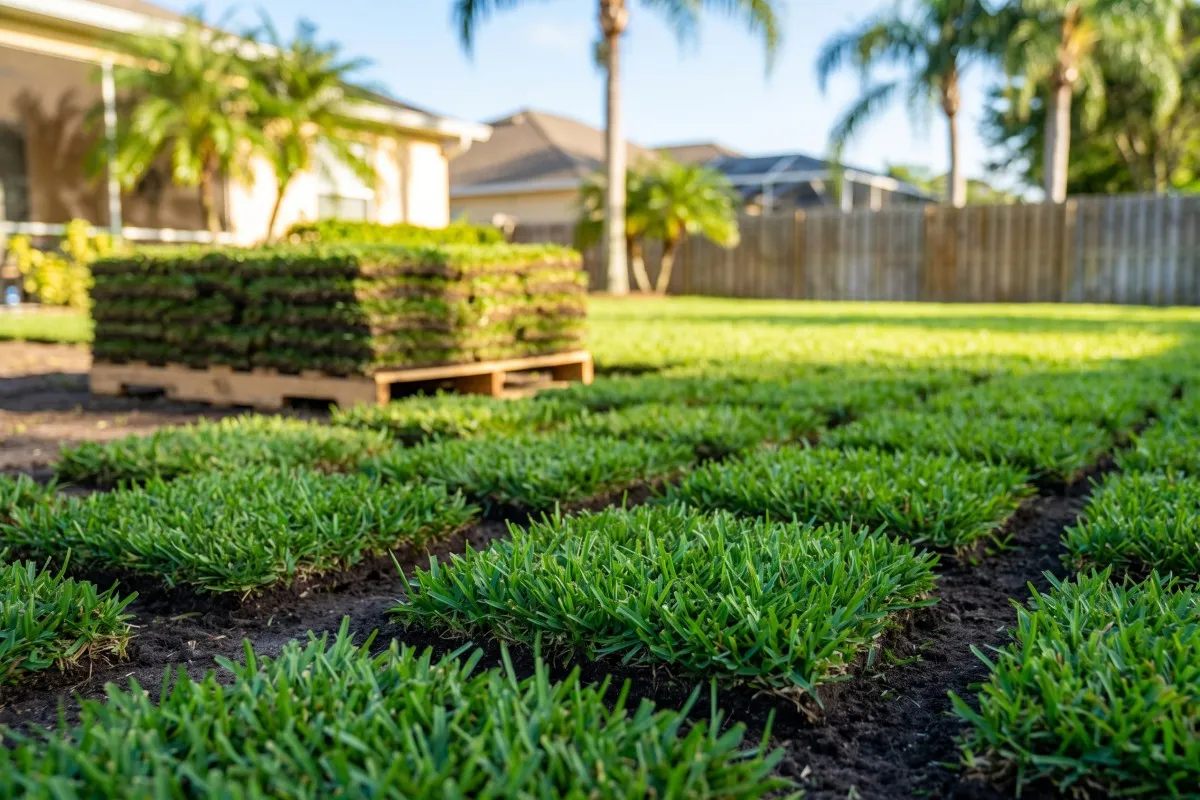
7 Questions to Ask Before Hiring a Sod Installer in Tampa Bay
The questions to ask a sod installer in Tampa Bay before you sign: seven that separate a real crew from a cheap one, from a family-owned team.
The Best Time to Install Sod in Florida? Why Tampa Bay Is a Year-Round Window
The best time to install sod in Florida isn't a single season. Here's how Tampa Bay's climate opens a year-round window, season by season.