
New Sod Care in Florida: A Day-by-Day Watering and Establishment Guide for the First 30 Days
A day-by-day new sod care watering schedule for Florida homeowners — anchored to UF/IFAS ET science and SWFWMD irrigation day rules for Tampa Bay.
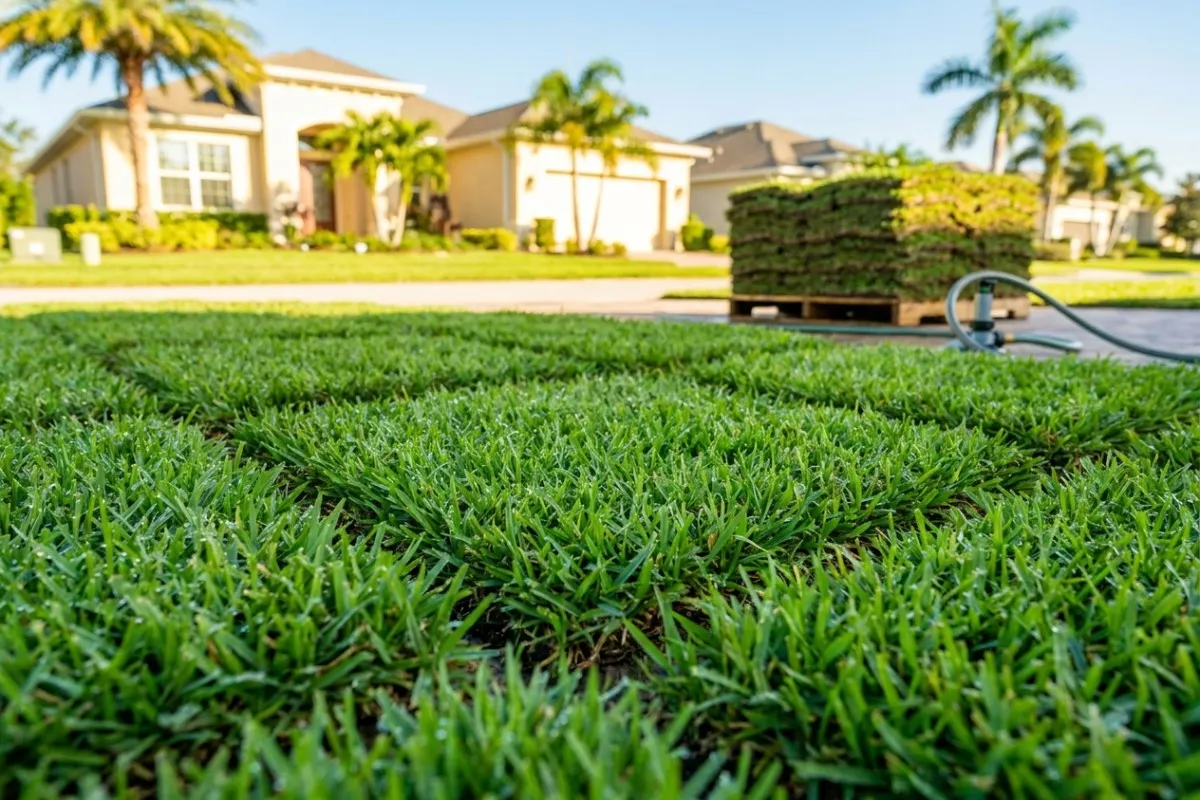
A new sod care watering schedule for Florida is not a set-it-and-forget-it matter. The first 30 days after installation determine whether a $2,000–$6,000 investment knits into the soil or slowly fails from the roots up — and in Tampa Bay’s summer heat, that window closes faster than most homeowners expect. This guide lays out a concrete schedule, phase by phase, anchored to the science behind why each stage looks the way it does.
Why the First 30 Days Are Different From Any Other Month of Lawn Care
New sod is not yet a lawn — it’s a mat of grass with severed roots sitting on top of soil it hasn’t yet claimed. Those roots were cut when the sod was harvested, and until they regenerate and penetrate the native soil beneath, the grass relies entirely on the moisture held in the two or three inches of growing medium attached to the underside of each slab.
In Tampa Bay during summer, reference evapotranspiration for turfgrass runs approximately 0.15 to 0.20 inches per day — roughly 1.0 to 1.4 inches per week. A lawn with an established six- to eight-inch root system can draw from deep soil and handle that demand on two or three irrigation days per week. New sod cannot. The top inch of soil dries out within hours on a warm Florida afternoon, well before the next cycle would arrive on a normal watering calendar.
Most St. Augustine sod begins developing shallow anchor roots within 10 to 14 days and a full root system within four to six weeks. Until deeper roots are in place, frequency of irrigation matters more than volume per cycle. The schedule below reflects that reality: it opens with frequent, short cycles and transitions toward the deep, infrequent watering that UF/IFAS Extension recommends for mature Florida turf — because the transition in the schedule mirrors what roots are actually doing underground.
The SWFWMD Establishment Exception: Handle This Before Installation Day
Most Tampa Bay homeowners are subject to Southwest Florida Water Management District irrigation day restrictions. Under normal Phase I rules, residential irrigation is limited to two assigned days per week based on your street address. Running irrigation three to five times per day on any day of the week — which is what new sod requires in its first week — is incompatible with that schedule unless you have the establishment exception in place.
SWFWMD provides a 60-day new landscape establishment exception that supersedes the normal day-of-week restriction:
- Days 1–30 after installation: irrigation on any day of the week is permitted
- Days 31–60: up to three days per week
Three requirements govern it:
Register before the sod goes down. The variance must be in place prior to installation — not the morning your crew arrives. Contact your local utility or SWFWMD to initiate the process at least a few business days in advance.
Allowed irrigation hours still apply. Even during the establishment period, your local utility’s prohibited daytime irrigation windows remain in effect. Hillsborough, Manatee, and Pinellas County each have slightly different allowed hours — confirm yours before scheduling early-morning or evening cycles.
Verify Phase III status first. As of August 2026, SWFWMD’s extended Water Shortage Order runs through October 1, 2026. Some utilities in the district have paused establishment exemptions during Phase III. Call SWFWMD at (813) 856-5679 or contact your utility directly before scheduling installation to confirm the exemption is available to you right now.
Getting this step right before the first pallet arrives protects the installation legally and logistically. A fine issued while you’re trying to nurse new sod through its first week is an avoidable complication.
New Sod Care Watering Schedule for Florida: Four Phases Over 30 Days
The schedule below applies to St. Augustine (Floratam, ProVista), Zoysia, and Bahia sod installed in Hillsborough, Manatee, or Pinellas County. It is drawn from UF/IFAS turfgrass fertilization and irrigation research and the Hillsborough County UF/IFAS 30-Day Sod Establishment Plan.
Summer installations (May–September) move through these phases faster because Tampa Bay soil temperatures run 80–90°F — conditions that accelerate St. Augustine rooting significantly. A winter installation may need each phase extended by one to two weeks, since rooting slows considerably when soil temperature falls below 65°F.
Phase 1 — Days 1–7: Keep the Root Zone Continuously Moist
- Frequency: 3 to 5 cycles per day
- Duration per zone: 3 to 5 minutes
- Goal: Top 1 inch of soil stays uniformly moist without pooling
Begin watering immediately on installation day — do not wait for the entire job to be complete before running the first cycle. As each section of sod is laid, that section needs water within the hour. Work the system zone by zone as the crew finishes each area.
Walk the lawn after every cycle. If sod corners lift easily and the soil below feels dry, add a cycle. If water is pooling or the surface feels squishy underfoot, reduce duration slightly. The target condition is consistently damp — never saturated, never dry.
By the end of day seven, the sod should lie flat and resist gentle hand pressure at a corner. Roots are still superficial, but the sod has begun making contact with the native soil below.
What to watch: A dull blue-gray color or curling edges in the first few days indicates the sod dried out during transport or during installation. Increase cycle frequency immediately. Brown streaks along pallet seams point to an irrigation zone that isn’t covering that section.
Phase 2 — Days 8–14: Taper as Roots Begin to Anchor
- Frequency: 2 to 3 cycles per day
- Duration per zone: 5 to 8 minutes
- Goal: Confirm rooting has begun; begin wetting slightly deeper soil
To verify that roots are developing, grasp a corner of one sod piece and pull gently. If it lifts cleanly with no resistance, stay on the Phase 1 schedule for two or three more days. If you feel resistance — the grass begins to tear before the sod pulls free — roots are anchoring into native soil.
Sod type plays a role here. Sand-bottom sod, grown on sandy soil rather than organic muck, integrates faster with Tampa Bay’s native sandy substrate because the root system encounters matching soil conditions from day one. That compatibility is most visible in these first two weeks, when rooting speed determines whether the schedule can advance on time or needs to be held.
If dry patches appear on a schedule that is otherwise on track, check irrigation head coverage and system pressure before assuming the watering frequency is the problem. A blocked head or a spray gap between zones can leave a strip of sod without consistent moisture.
Phase 3 — Days 15–21: Train Roots to Follow Water Deeper
- Frequency: 1 to 2 cycles per day
- Duration per zone: 15 to 20 minutes
- Goal: Encourage root extension into deeper soil; begin transitioning away from surface moisture maintenance
The approach shifts in Phase 3. Rather than maintaining surface moisture, longer cycles now wet soil several inches below the surface — and roots extend downward to follow it. This is the beginning of the deep-and-infrequent watering pattern that UF/IFAS Extension recommends for mature Florida turf, and it makes biological sense only once roots have something to follow.
Skip a scheduled cycle on any day when rainfall exceeds half an inch. Tampa Bay’s summer storm pattern — brief, intense afternoon downpours — often delivers that threshold in under 20 minutes. Overwatering a lawn still in establishment promotes root rot and fungal disease at the exact moment the grass is least equipped to resist it. Once the lawn is fully established, managing the balance between summer rain and supplemental irrigation becomes its own seasonal discipline; our guide on Florida’s rainy season and lawn care covers that in detail.
First mow: Target days 14–21, once the sod resists being lifted. Set the blade height to 3.5–4 inches for St. Augustine and remove no more than one-third of the blade length in a single cut. Use a sharp blade — a dull mower shreds sod that hasn’t fully rooted and can disrupt the root contact you’ve spent two weeks building.
Phase 4 — Days 22–30: Transition to Your Permanent Schedule
- Frequency: 2 to 3 times per week
- Duration per zone: 20 to 30 minutes
- Goal: 0.5 to 1.0 inch of water per week, accounting for actual rainfall
By the final week of the first month, irrigation should resemble the UF/IFAS recommendation for established Florida turfgrass: 0.5 to 1.0 inch of water per week in total, adjusted for rainfall. A smart irrigation controller with a rain sensor automates this correctly. Many Hillsborough and Manatee County utilities offer rebates for ET-based controllers that calculate irrigation need from local weather data rather than running on a fixed timer regardless of recent rainfall — worth investigating if your current system doesn’t already have one.
This is also the week you formally exit the SWFWMD establishment exception and return to your normal assigned watering days.
Fertilization: Wait at Least 60 Days
UF/IFAS research on newly installed St. Augustinegrass sod found no benefit to fertilizing during the establishment period. With roots too shallow to capture applied nutrients, fertilizer leaches through the sandy soil profile before the grass can use it. Fresh-cut sod carries sufficient stored nutrients in its leaf tissue to fuel early root development. Wait a minimum of 60 days after installation before applying any fertilizer.
Signs That the First 30 Days Are on Track
- Days 3–5: Sod lies flat; corners no longer lift or curl under normal heat
- Days 10–14: A gentle corner pull meets resistance; roots are anchoring
- Days 14–21: Lawn supports foot traffic without depressions; ready for first mow
- Day 30: Grass tolerates normal use; irrigation normalized to 2–3 days per week without visible stress
If widespread yellowing persists past day 14, check irrigation coverage and system pressure before reaching for fertilizer. Applying fertilizer to a lawn still in establishment does not accelerate rooting and can add stress to a plant system already operating at the edge of its capacity.
If sections go fully brown and stay that way past day 14, the cause is more likely a subsurface issue than a watering schedule error — a low spot holding standing water, a soil interface problem between the sod and native ground, or pest activity. Our guide on diagnosing and repairing bare and brown spots in a Florida lawn walks through the field tests that distinguish drought stress from fungal disease from pest damage, and matches each cause to the correct repair.
The Investment Worth Protecting
The root architecture that develops in the first 30 days shapes how a lawn performs through the following summers, drought periods, and pest pressure cycles. Normalizing irrigation at day 10 because the lawn looks green — or cutting cycles during a trip without arranging coverage — is the most consistent way a well-installed sod job fails within its first season. The schedule above is not complicated, but it requires attention precisely when attention is least convenient: in the first two weeks, before the lawn has anything to show for it.

Fresh-cut sod installation, replacement, and delivery in the Tampa Bay area.
Continue reading
Why Is My New Sod Turning Yellow? Troubleshooting the First 30 Days in Florida
New sod turning yellow in Florida? Learn the three causes in the first 30 days and a simple decision path to adjust water, treat, or call your installer.
Sod Warranty in Florida: Why It Won't Save Your Lawn
The truth about a sod warranty in Florida: why sod is a living product, why guarantees are often gimmicks, and what actually protects your new lawn.
7 Sod Installation Mistakes Tampa Bay Homeowners Make (And How to Avoid Them)
The 7 sod installation mistakes Florida homeowners make most, what each one looks like weeks later, and how our Tampa Bay crews avoid every one.